The University Steps: Guanajuato’s Green Cantera Staircase
The Edificio Central’s great staircase: the 1950 to 1955 build, the student quarter around it, and how to use the city’s best free seat.
It is the most photographed staircase in Mexico that leads to a rector’s office. The Edificio Central of the Universidad de Guanajuato climbs out of a Centro street on a single flight of green stone, 86 steps wide enough for a graduating class, up to a facade that reads like a castle keep. Students live on these steps; visitors climb them for the view back over the rooftops. The attractions list gives the staircase a line; this page gives it its due, because in Guanajuato the university is not a campus on the edge of town. It is the town’s second skyline.
| Question | Researched figure |
|---|---|
| The building | The Edificio Central of the Universidad de Guanajuato, on Lascuráin de Retana in Centro: the university’s seat, holding the rectoría and the law division |
| The staircase | Green cantera stone, 86 steps by the count most often published, climbing to the Auditorio General beneath the facade inscription “La verdad os hará libres”, the truth will set you free |
| The dates | The staircase was begun on 4 February 1950 under the architect Vicente Urquiaga Rojas and inaugurated in 1952; the whole building was completed on 20 August 1955 (the university’s own record) |
| The institution | Descends from the Jesuit Colegio de la Santísima Trinidad, its hospicio founded in 1732 and recognized by royal cédula in 1744; a university since 1945 |
| Visiting | Free and public at all hours. The steps are a gathering place, and host concerts, open-air cinema and the city’s monumental Day of the Dead altar |
| Page verified | November 2026 |
A staircase as a front door
The university had a problem in the 1940s: boxed into a Centro block with nowhere to grow sideways. The architect Vicente Urquiaga Rojas proposed growing up instead, and the result, built between 1950 and 1955 in the green and purple cantera of the local quarries, is this deliberate piece of theater: an auditorium raised on a ceremonial stair, in an eclectic dress of Gothic, baroque and Renaissance detail, held up, remarkably, by its own stonework without a metal skeleton. The staircase was inaugurated in 1952, the building finished three years later, and the steps have been the university’s portrait ever since, the image on the prospectus and the backdrop of every graduation photograph in the state.
The student quarter
The steps stand on Lascuráin de Retana, named for the 18th-century benefactor whose haciendas endowed the old college, and the streets around them are the student quarter: bookshops and copy shops, cheap cafés, the university’s own museum a short walk away with the institution’s history and its mining cabinets. The university is woven through Centro in faculty buildings rather than fenced into a campus, so the quarter has no gate; it simply thickens as you approach the staircase, until the steps themselves take over as the neighborhood’s plaza, lecture hall and living room.
Sitting on the steps
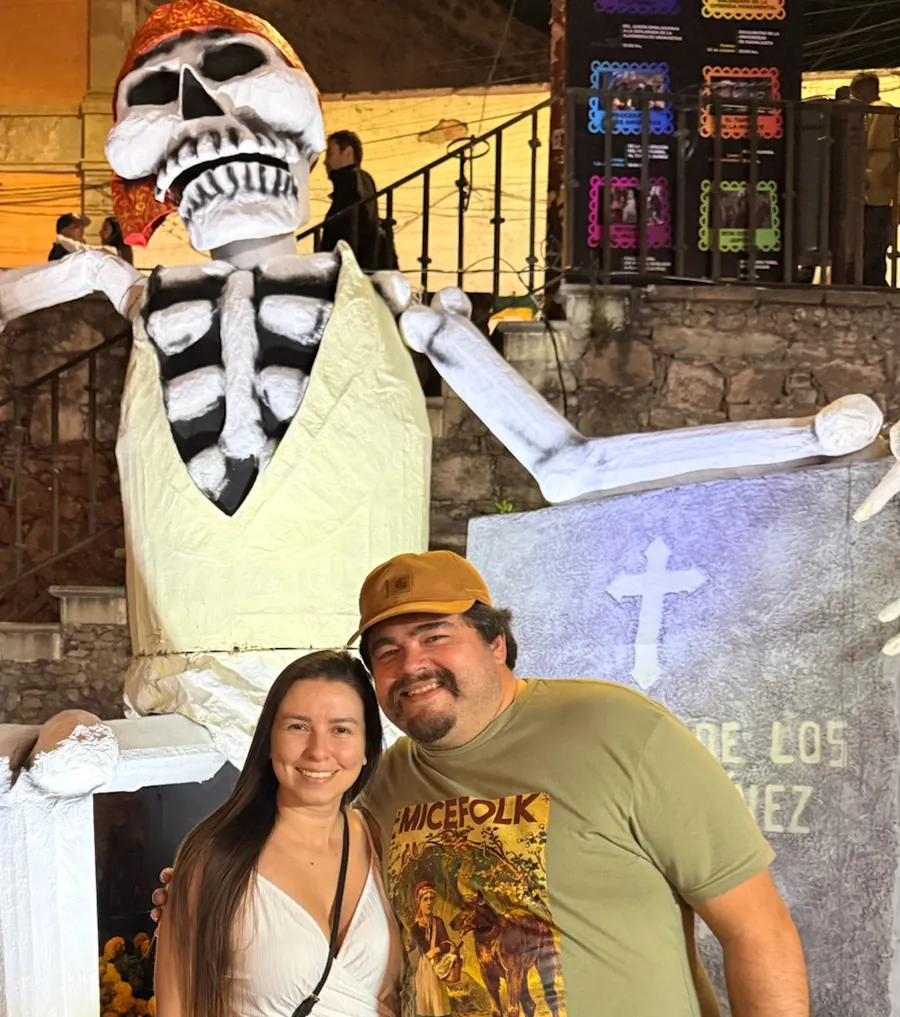
Use them as the students do: as a seat with a view. Climb to the top for the look back over Centro’s rooftops to the hills, then sit halfway down and let the city perform. Through the year the staircase moonlights as the city’s open-air auditorium, with concerts on its landings, cinema projected against the facade in festival weeks, and, at the start of November, the monumental Day of the Dead altar built up its flights, one of the largest in the country. There is no ticket and no hour; the only etiquette is the obvious one, that this is a working university, so the steps belong to the people crossing them with books under their arms. Give them the middle. The sides are for sitting, and the sitting is excellent.
Walking tours that climb here
Every historic-center walk ends up at the staircase sooner or later; the guided versions put the university’s story in order:
Places in Centro
Next steps
Museo Casa Diego Rivera
The painter’s birthplace museum, two streets away on Positos.
Attractions in Guanajuato City
The verified core list this page belongs to, with what to skip.
Teatro Juárez
The theater at the bottom of the hill, and how visiting works.
Guanajuato City
The hub: the city’s sights, stays and days, planned.